Monday, January 26, 2009

Level Best

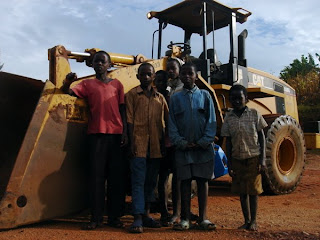
Last week we began leveling the site for the new buildings at Prince Primary. Four months ago I would have pretended to know what that really meant, and thanks to the unexpected generosity of Reynolds Construction Company – an Israeli-owned outfit building new roads from the capital of Kampala to the southwest town of Mbarara – we are conquering this task relatively cheaply. Other than some after-hours fuel and auxiliary motivation for the machine operator working on his Sundays off, we are receiving the service as a donation. Lesson: Be fearless in asking for help from others. This is not my project, or Project Focus’s project, or even a project limited to this community, but rather a project to improve humanity on a small scale, and all people should be expected to give what they can. Even though this is a relatively small stage of the project, I was absurdly excited to watch the first cuts into the red mound of earth where the new school will sit, and I wasn’t alone. Dozens of community members came out and sat with me for hours as we savored in the initial (tangible) signs of change.


Since Christmas I have spent a good portion of my time around Prince doing interviews for a recently completed radio documentary about the school’s history, struggles, strengths and what the all stakeholders see as the path to success. I interviewed the founders, staff, students, parents and guardians, and the headmaster of the nearby government school to get a sense of the community involvement in both public and private school circumstances. I am very happy with the results of the piece, and if I ever find a way to email the 18-minute file, you can make your judgments.


The search for our dream-engineer continues. It’s not easy to find someone who is willing to work with our approach of community involvement, stringent accountability and transparency guidelines, and relatively bizarre methods of fundraising… all at the right price. Especially when the “right price” seams to be a bit of an anomaly. Of all the consultations I’ve gotten the estimates for essentially the same building (a few variables) have ranged from $45,000 to over $600,000. I’m not exaggerating. It’s been a mystifying but advantageous experience in which I’ve learned about things like corruption, corruption and corruption. I’ve got our search narrowed down to a few trustworthy candidates and will be deciding within the weeks end.

Last Wednesday Lyantonde had a visit from Uganda’s hottest music duo called Moses Radio and Weasel. It was damn fun to see everyone that I greet and chat with from around town all in one place, dressed to kill and letting loose at the concert. I had a ridiculously good time and gained a new level of respect once I unleashed my rug-cutting prowess.

Sunday, December 28, 2008

Village Christmas

Being apart from friends and family around the holidays can be emotionally arduous but I claim an evolved freeloader instinct. No matter what the distance from home or how little I have to offer potential hosts, I always end up around those transformative families whose love and openhandedness towards wanders calls to me. Christmas in Lyantonde was nothing unfamiliar. Jackie and Olivia – sisters among the brightest and most outspoken students a Prince Primary School – invited Jonathon St. Clause and me to their home for Christmas lunch in the village of Kalegero. The experience was pure. We carried gifts of huge jackfruits by motorcycle to Prince to meet Jackie and followed her the rest of the way on foot. We arrived and greeted the younger Olivia, Jajja (grandma), grandpa, little brother Henry, and uncle Mark. They welcomed us with fresh mangos and watermelon and we chatted about their land, Mark’s med-school studies, American life, Prince Primary, and how we love food. Jonathon and I tried to pepper the conversation with our limited Luganda but most of the day we communicated with Jajja via Mark’s translation. The family packed us full of every vegetarian dish in the Ugandan cookbook, introduced us to their alpha-piggybank (his promiscuity puts the girls through school), and gave us a tour of their gardens. The girls shared with me Akon lyrics, their top-secret solutions for high-level government corruption, some family history and career aspirations: Jackie – lawyer, Olivia - doctor.

Jajja is a tough woman. I met her a few days back when she agreed to sit down with me and discuss some of her opinions for the school’s improvements. I had gotten the impression that she was the mother of the girls because they call her maama, but deeper into our conversation she allowed some details of their situation. Their family history is complex but sadly typical. I am gathering it now for an audio piece on Prince Primary that will feature the girls’ story – so watch for it. For now lets just say… the fact that the girls still possess that kind of drive to educate themselves and give back speaks directly to Jajja’s influence in their lives. Watching them in action together at their home made it clear. The peeling and matted turquoise walls of their living room - lit by the pre-rain afternoon sky - suggested an almost meditative mood in which the girls and jajja floated around effortlessly anticipating each other’s needs.

I’m incredibly fortunate to have these kinds of experiences on a daily basis, and I’m truly grateful. My affinity for Lyantonde, and Ugandan in general seems to be at a perpetual apex, and it’s difficult to even consider the spectrum of things I am learning about. The work has been slow but encouraging, and I want thank the folks in Project Focus for being my surrogate family and reminding me to step back every so often to take it all in.
Remember to be happy.

(pics will not load on thecomputer I type from but they are coming)

Saturday, December 6, 2008

Bitone in Ethiopia!

Addis Ababa has been amazing! I learned before we left Uganda that the festival organizers should have “been sent the broom” as Branco from Bitone so brilliantly put it, but the kids didn’t let that stop them from destroying the competition. They had 5 performances during 6 days of music, theater, and storytelling from Ugandan, Tanzania, Kenya, Sweden, the U.S. and the many provinces of Ethiopia. For months leading up to the journey Bitone worked to combine selected instrumental pieces, dances, and narration to create a 45 minute production/story about a wealthy princess’s search for a husband based on his artistic talents, knowledge of culture, and sense of self; not his family’s financial/social status.

They warmed up with 2 shows at Hager Fikir Theatre. The sound and lighting operators made me want to swallow broken glass and gasoline (they had been swallowin something else) but the kids hung with it and rocked the packed houses. Then came the real fire (the kids constantly refer to a good performance as “bringing fire”) - the headmaster of Addis’s most prestigious primary/secondary school – St Joseph’s- caught wind of Bitone’s show and invited them to perform for his entire student body. It was the biggest audience they had ever played for but they handled it with the swagger of veteran artists. Playing for their peers was obviously more comfortable for them and the Ethiopian students received them with deafening standing ovations. It chokes me up to write about it. The show was perfect and I had thought it would have been the best I would see from them for a while, but that same night they had another last-minute invitation. They were asked to perform at the ritzy Addis Hilton for a fashion show put on by the American Chamber of Commerce in Ethiopia. Outside of hanging with Ethiopian models this idea rubbed me the wrong way from the beginning and I ended up getting into it with the coordinator because he had us arrive 5 hours before our performance and then refused to feed the children from the posh buffet all the snazzy Americans were wasting. But back to the Ethiopian models… are you f#*king kidding me? The average Ethiopian woman already makes me want to cry tears of gratitude for the genius design-sense of the creator. The Bitone girls shared a dressing room with the models and I found as many “administrative” reasons as possible to urgently enter and speak to them. Roscoe – the 16 year-old man of the Bitone home – whispered to me, “Grant, I think God made a mistake. He put all the beautiful women here and made Uganda too far away.”

Once Bitone hit the stage they killed it. The set-up was perfect for their production. The sound was pristine and the girls used the runway as their dance floor. Even though it was a corporate function the energy of the place was electric. The crowd lost their minds and when all was said and done the children were served a 3 course meal in a private room… and two models slipped me their phone numbers. Ha! Of course they were then asked to close the entire festival at Hager Fickir on the last night, and fresh off my victory over the Hilton coordinator I demanded to do the sound myself. It was much improved and Bitone brought the house down to end an amazing week of artistic exchange from all over the globe.

The kid’s reactions to culture shock were deep. For the first time they were approached by beggars even though they exist everywhere in their home country. They got a better understanding of being stereotyped – just because they are foreigners and standing in front of a relatively nice hotel they are assumed to have money, and got constantly hassled. I have been struggling to expand their minds as far as food goes because they are used to eating the same 3 things everyday for their entire lives, and Uganda is damn hot; the cooler weather in Addis has been frustrating for the group of kids, many of whom have never owned a coat. Italian influence here is very evident here and Ethiopia’s history of fighting off Italian colonization crept into most conversations between the kids and locals. It gave them (and me) some serious homework to do.

They had to get out of their shells socially as well; they were the only youth in the festival and were forced to mingle with hoards of grown-up artists from all over the world who were dying to praise them. For this I feel they were better prepared than most Ugandan children would have been. At Bitone the children are encouraged to express themselves emphatically, even to adults, which is definitely not the cultural norm in Uganda. From my experience if 2 or more adults are in a room talking the children are sent out. Again I take my hat off to Branco and Hassan for creating such a loving and nurturing environment for these beautiful and talented children to grow into beautiful and talented adults. I have felt so much closer to the kids since returning to Uganda this time around but during this trip I have definitely become part of their family. Special thanks to all who have bought a Bitone cd, responded to my emergency email, listened to me mindlessly blab about how much I love them, or helped out in any other way. You should be as proud as I am.

As usual I think it’s only fair to share all aspects of an experience, pretty or not. Addis Ababa reminds me of Los Angeles from some reason. The tall buildings mixed with scattered palm trees, the expansive and broken-up layout, cool nights and grey mornings, and similar little pockets of grime. You can be in a totally “safe” looking area and turn down a tiny side street and be in the shit. One night after a performance I was walking the kids back from a late dinner, when we got back to the hotel I realized I forgot the receipt. I have reoccurring nightmares where Harish softly whispers the word “accountability” over and over like Chinese water torture in my ear so I went back to get it. On the way back to the hotel I was coming down one of these side streets and I heard and saw something strange. As I got closer it got clearer, a man was trying to rape a women up against a wall. Confused, I looked around and there was some fucking coward taxi driver sitting in his car and watching it right next to me. I looked at him and put my hands up in a way to ask what the hell is happening and he says “don’t worry they are friends”. I walked closer to the two and could clearly see the woman crying and faintly fighting back in way like she has been fighting this battle her whole life and was too tired to fight again. When the man (he looked maybe 17) realized I was coming he frantically started back peddling and repeating “sorry my friend, no problem” and then ran. The women ran in the other direction. I had such a rush of anger that I went to the taxi driver and tried gave him a piece of my mind but it was pointless due to a combination of language barrier and the fact that he obviously doesn’t give a shit anyway or he wouldn’t have been casually watching a woman get raped in the first place. That was night number 2 and since I have been going grey trying keep every Bitone girl within my sights at all times. They are all so beautiful and now I want to fight every time a man looks at them. My daughters are going to hate me.

Saturday, November 22, 2008

Project FOCUS & World AIDS Day

December 1st is World AIDS Day and Project FOCUS is participating in a Boston event commemorating World's AIDS Day at St Mark's Congregational Church in Roxbury.

St Mark's is a prominent African American community church that seeks to create a dialogue about AIDS in the African American community and help memorialize those who have been lost to this devastating virus.

Project FOCUS will display our HIV/AIDS quilts from Uganda and discuss how stigmas and struggles faced in Africa are similar to those that exist in the United States. We will also participate in a panel discussion about AIDS and women of color.

Friday, November 21, 2008

On Saturday, November 22nd, Project FOCUS members Madelene Griffin, MAAT and Meg Wolf, MAAT will present at the Annual American Art Therapy Conference in Cleveland, OH.


The Art of Discovering: Re-defining Art Therapy Within the Context of Ugandan Culture

In 2007, a small group of artists and art therapists traveled to Southwest Uganda with an organization called Project FOCUS and implemented four pilot projects intending to educate, empower and inspire through art. This workshop explores their discoveries during a challenging 5-month journey using images, personal narratives, and examples of artwork created with local materials.
Project FOCUS: Creative Dialogues Exhibit
November 13th - December 31, 2008

On November 13th, Project FOCUS celebrated the opening of its first exhibit in New York; Project FOCUS: Creative Dialogues. The exhibit features photography by Gloria Bernard and the artwork created by the community members of Lyantonde.

The exhibit will be up through December 31st, 2008.

Gallery Location:
The Bronfman Center Gallery
7 East 10th Street NY, NY 10003

Gallery Hours:
Monday-Thursday: 8am-10pm, Friday: 8am-4pm, Saturday: CLOSED, Sunday: 9am-9pm

Sunday, November 9, 2008

Election Fire


I have to begin with recognizing the amazing achievement that is Barack Obama! This monumental moment in history gives me hope that sometime in the not-so-distant future, the work of organizations like Project Focus will be operating abroad to compliment the positive impact of American foreign policy, and not simply attempting to alleviate aspects of the suffering directly caused by it. I know I'm not the only one with these lofty hopes, as I was fortunate enough to spend the days surrounding the election in Kenya, where the electricity had to rival places like Chicago and New York. As you know, most Kenyans claim Obama as their "son in the White House", and see him as a new source of national pride. The streets were electric with chanting marchers, taxi drivers worked their horns and voices to death with Obama's picture taped to every inch of the vehicles and newspaper salesmen – ten to every corner - proudly wielding the victorious front-page headlines - "Yes We Did". I literally just got off of a 20-plus hour bus ride back to Uganda (15 of which in the back seat, if you know the roads here you feel for me now) and still couldn't wait to get to a computer.


Confidence


The weeks leading up to the elections were just as exciting for me in Lyantonde. I spent the bulk of my time holding community meetings in the 7 villages that were home to lasts year's project participants. I returned to each community to update the members on the work of PF since leaving Uganda last December, listen to any changes they have experienced in their lives, and share with them our aspirations and course of action for the future. I presented to them the extent in which they will be expected to contribute to the development planning and implementation process, and although some of the meeting started off with words of skepticism and doubt, most ended with the communities scheduling elections of their own to establish project planning committees. I explained to them how communities like theirs are usually represented in the mainstream media outlets of the West. They laughed in disbelief, and agreed that the sharing of their stories of suffering and cultural richness, frustration and perseverance will build a better understanding of the complexities of their daily lives. I left each village chairman/chairwomen with a translated list of project criteria that will be explored thoroughly before we can begin finalizing any proposal. Those who seemed genuinely interested expressed a solid understanding and appreciation for our approach. An extremely summarized version of the criteria looks like this: Sound Financial System, Community Investment, Sustainability, and a Trusted Implementing Partner/Committee.

Prince Primary School – the first of the 7 development projects – is moving along at a comfortable pace. A local engineer has completed a topographical survey of the school's property. I've received a topographical map (including levels, size measurements and existing buildings) and price quotes for the leveling of the site and the cost of completing an actual architectural blueprint of the future site plan (including a list of specs and bill of quantities). I plan to check his numbers against other engineers and organizations with experience in school renovation. I also look forward to having our first Ugandan board of advisers meeting sometime this month, beginning Price Primary's pen-pal program (in partnership with an Falcon Heights Elementary School in St. Paul, Minnesota) titled "Citizens of the World" and Bitone's journey to Addis Ababa, Ethiopia for their performance in the East African Theater Institutes's annual cultural festivals.

Movie Night


One night after a late dinner last week, I was walking home through Lyantonde and passed by the local theater. Because the power in the rest of town was off, I could better hear something out-of-the-ordinary coming from inside - something about "Chicago", "Harvard" and "his wife Michelle". I hadn't even started to shift my eyes toward the building to see what I was hearing when one of the dozens of theater salesman had me by the arm and was escorting me in. "My American brother"… "you will like" , "you will like" , "Obama" , "you go" , "you go"… "give me 200." Next thing I know I'm in the theater that's usually home to bad action videos from the states (Nick Cage, Steven Seagal, etc, dubbed in Luganda at insane volumes), Nigerian soap operas, or English Premier League football matches. I never thought of setting foot in that place before that moment, due to its bad reputation as a "thieves den", and now I'm sitting with at least 50 young Ugandan males in dead silence watching an Obama documentary in English. My eyes burned from of the overwhelming smell of Waragi (Ugandan's national drink originally named "war gin" by British soldiers during WWI) which added to the surreal experience. Everyone was glued to the screen, and I can't imagine that too many others besides me could fully understand the film's narration. That's what made it so powerful. The world is waiting for this man, or at least what he represents, which to me is a renewed sense of service and personal responsibility in each other. The same sense that makes a room full of 20-something Ugandan males – already labeled as thieves by their community - sit down and try to educate themselves by watching a documentary in a language they don't speak, about a man in whom they see hope.